
Four Agreements, Fourteen Years and the Check Nobody Ran
- November 17, 2026
- Posted by: Justin Prince
- Categories: Employment Law Support, Human Resources and Industrial Relations
Whenever a large underpayment lands, the same explanation turns up within the hour, usually from an employer association and usually with the word “complexity” somewhere in the first paragraph. The award system is a maze, the argument runs, and even well-meaning employers get lost in it. I have some sympathy for that when the employer is a civil contractor working out which of the on-site award’s allowances attach to someone who spent the morning in a trench and the afternoon somewhere else entirely, or a pharmacy owner rostering across evenings, Sundays and public holidays. Mining and manufacturing have their own versions. Those instruments are hard, and I have spent enough years reading them to say so without embarrassment.
Banking is a different matter.
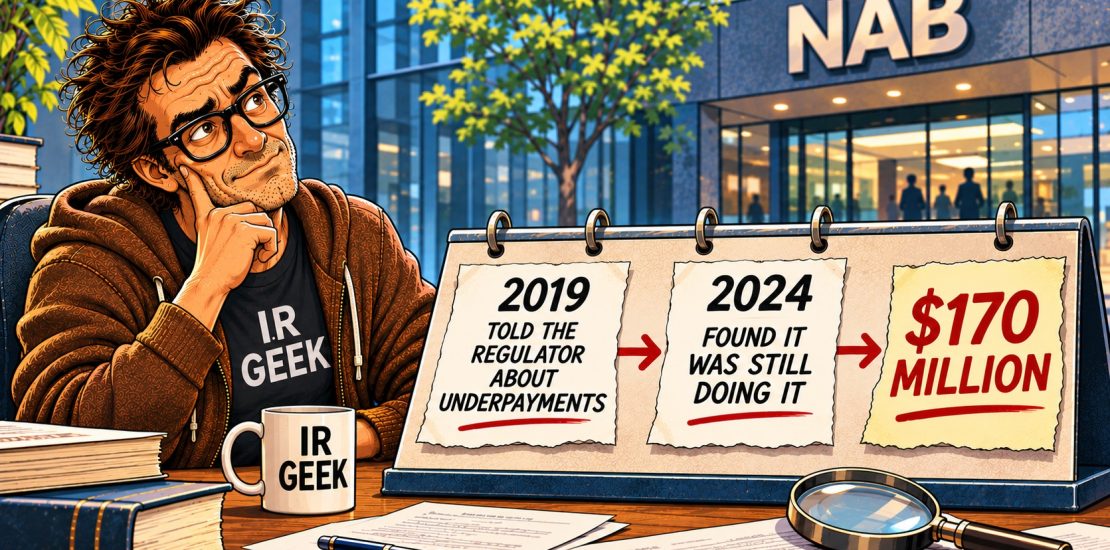
On 12 November the Fair Work Ombudsman announced an enforceable undertaking from National Australia Bank. The undertaking records $127,672,479 in underpaid wages owed to 65,999 current and former employees. Add $34,017,421 in interest, plus superannuation, and the total comes to $170,324,325. The underpayments run from October 2012 to this year. NAB will also pay $2 million in contrition to consolidated revenue, which the FWO says is the largest such payment in any undertaking it has executed.
Those are the numbers every outlet ran last week. The more useful question is how a bank manages it.
What NAB was working with
The Banking, Finance and Insurance Award 2010 is about as gentle as modern awards get. It has a handful of classification levels, a mostly weekday workforce, and nothing resembling the allowance schedules that keep construction payroll officers awake at night. NAB was not even paying under it. For the whole period the bank was covered by its own enterprise agreements, made in 2011, 2014, 2016 and 2024, which means every clause it failed to apply was a clause it had sat across the table and agreed to.
The Ombudsman made the same point with more restraint than I might have managed. Anna Booth called it “particularly disappointing” that a well-resourced employer negotiated its own terms and then did not have payroll systems capable of delivering them before they took effect.
Why it turned
The causes listed by the FWO read like every other large corporate matter: governance gaps, poor records, legacy payroll technology, and too little investment in people who understand payroll. All true, I am sure, and none of it tells you very much.
The detail that matters sits further down. NAB’s agreement required regular reconciliations, comparing what staff were actually paid against what they would have received under the award, with any shortfall to be paid. NAB did not run them. It was also not properly capturing time and attendance, which is the part people skip past, because you cannot reconcile hours you never recorded.
That is the whole mechanism, and anyone who has drafted a salary clause will recognise it. An annual salary is offered in place of overtime, penalties and allowances. The agreement makes that arrangement safe by promising a periodic check that the salary still beats the safety net. The check depends on time records. Salaried bank staff, like salaried staff everywhere, are not in the habit of filling in timesheets, and their managers are not in the habit of asking. So the promise sits in the agreement, signed by the parties and approved by the Commission, while nothing in the business is built to keep it. The affected roles tell the same story: branch managers, lending bankers, risk analysts, project managers. Salaried people working additional hours that nobody wrote down.
The timeline is worse than the cause. NAB self-reported in late 2019 after finding errors in how it had implemented its then current agreement, and the review that followed traced non-compliance back to 2012. Then in 2024, while implementing the next agreement, it found the problems had not been adequately identified or fixed and that staff were still being underpaid. Five years into a remediation program, with the regulator already in the room, the bank rolled a new agreement onto the same foundations.
The pattern
On its own, NAB is a large number. Set beside the others it becomes a trend.
In February 2024 Bromwich J imposed combined penalties of $10.34 million on Commonwealth Bank and CommSec in Fair Work Ombudsman v Commonwealth Bank of Australia [2024] FCA 81, over $16.07 million underpaid to 7,402 employees. The failure there was the same species: agreements and individual flexibility arrangements that depended on regular reconciliations and top-up payments, which were not done. His Honour observed that the companies were “amply able to prevent anything of this nature occurring in the first place”.
Suncorp signed an undertaking in June 2023 covering more than 15,800 staff and about $32 million including interest and super. IAG followed in April 2024 with more than 19,000 staff and more than $21 million. Westpac signed one in 2021 over long service leave and a second in November 2025 covering nearly 47,000 staff and more than $50 million. Now NAB.
That is three of the big four banks and two of the country’s largest insurers inside five years, in an industry with a simple award, deep HR functions, in-house employment lawyers and, one assumes, a working knowledge of arithmetic. The contrition payments have climbed with each one: roughly $344,000, then $520,000, $650,000, $800,000 and now $2 million.
Geek assessment
There is no new law here. An undertaking under section 715 is not a judgment and binds nobody but NAB.
Taken together with CBA, Suncorp, IAG and Westpac, though, it leaves the complexity argument with very little to hold onto in this sector. The instruments were simple and mostly self-authored. What failed in each matter was the ordinary discipline of recording hours and checking pay against them, and in at least two of the five the check that failed was one the employer had written into its own agreement.
The term the FWO describes as a first tells you where it thinks the root cause lives. NAB must plan the implementation of any new enterprise agreement through a steering committee chaired by its Group Executive People and Culture, and satisfy itself that its systems can deliver everything the agreement requires. I read that as a regulator concluding that bargaining and payroll have been living in separate buildings. Anyone who has finished a bargaining round at eleven at night knows how this goes. The deal is done, everyone goes home, and three weeks after approval someone in payroll opens the agreement for the first time and asks what clause 23.4 is supposed to mean in the system. I would expect that term to appear in the next large undertaking, and the one after that.
The average is worth a second look as well. About $1,934 a head across fourteen years is small money per person per year, and that is how a problem like this survives. Nobody complains about a shortfall they cannot see, and no manager goes looking for one.
What to do with it
If you pay annualised salaries under an award or agreement, find the reconciliation clause and ask who owns it, by name. If the answer is a team, nobody owns it.
Check whether your salaried people record their hours. If they do not, your reconciliation is fiction, however tidy the spreadsheet. NAB’s undertaking includes mandatory training on recording additional hours, which tells you how basic the gap was.
Put payroll in the bargaining room, or at least in the drafting. Before a claim is agreed, someone should be able to explain how the system will calculate it. If the answer is “manually”, cost that honestly, including the cost of getting it wrong for a decade.
Test the configuration before the agreement starts operating, and do it against real rosters and real hours.
When you find an error, fix the cause before you finish counting the cost. The five years between NAB’s self-report and its rediscovery of the same problem is the expensive lesson in this undertaking.
And tell the board in plain terms. Intentional underpayment has been a criminal offence since 1 January 2025. Nothing in the NAB material suggests intent, but as a general proposition a known and unfixed underpayment becomes harder to describe as an accident with every pay run that passes.
Closing
The complexity argument will be back the next time a big number is announced, probably within the hour. It deserves a hearing when the instrument really is hard. In banking the instrument was written by the employer, and the missing piece was a check the employer had promised to run.
Somewhere in Australia a remuneration team is finalising next year’s salary review for a few thousand people who have never filled in a timesheet. It might be worth someone asking them about the reconciliation clause before the Ombudsman does.