
- July 7, 2026
- Posted by: Justin Prince
- Category: Industrial Relations
An IR Geek half-year review: April to June 2026
Industrial relations practitioners are only let out of the dungeon twice a year, and this is one of those occasions. The half-year review. We blink at the sunlight, ask what season it is, and try to explain what the Fair Work Commission has actually been doing while everyone else was reading the headlines.
This time, though, something is different. The Commission has stopped explaining itself.
The FWC Bulletin, the tribunal’s own monthly digest of the decisions it thought worth understanding, published its final edition on 25 June. The stated reasons: an unprecedented increase in workload, engagement levels, and the availability of other subscription options (FWC Bulletin 6/26, 25 June 2026). Which is a polite institutional way of saying the tribunal is so busy deciding things it can no longer afford to tell you what it decided.
Sit with that for a moment, because it turns out to be the story of the entire quarter. Not any single case. The institution itself: under siege from its own caseload, naming generative AI as one of the culprits, tightening its procedures in response, and then, in a series of Full Bench decisions, drawing a very firm line about how much fairness can be sacrificed to efficiency. Including, notably, by its own Members.
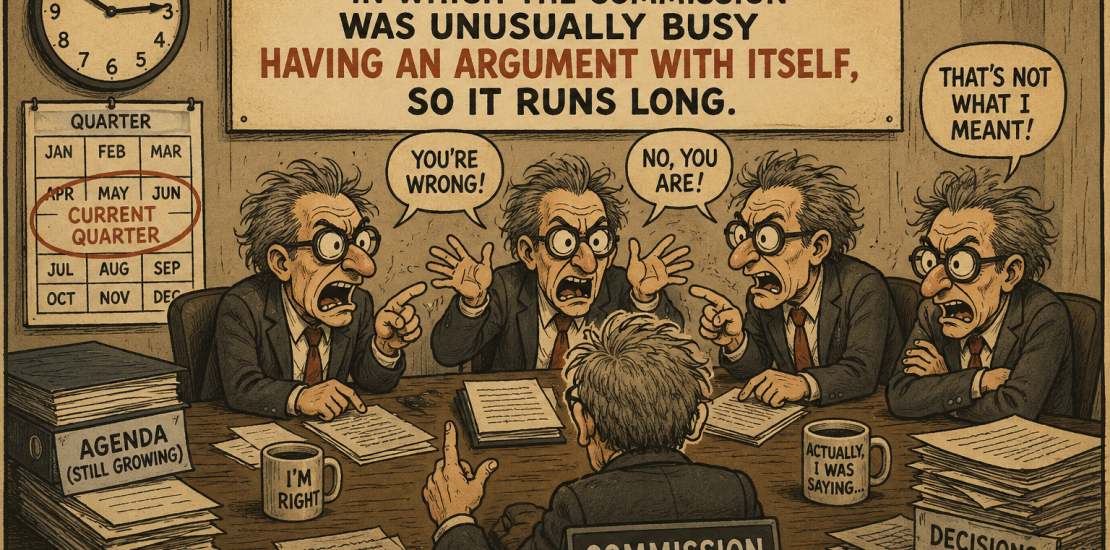
A reader’s map. This one covers a full quarter in which the Commission was unusually busy having an argument with itself, so it runs long. Each section stands on its own, and each ends with a Geek assessment. If you are truly pressed, reading only those will get you the argument in miniature. Otherwise, jump to whatever keeps you up at night:
- The siege, documented: AI-drafted claims, a drowning tribunal, and two Full Benches quashing their own colleagues. For anyone wondering why everything at the Commission suddenly has a seven-day deadline.
- The algorithm that couldn’t consider: Ayyub v Portier Pacific, the decision of the quarter. Uber’s automated deactivation system fails, and your HR tech stack should be paying attention.
- The evidence quarter: seven dismissal cases, seven different decision-makers, one fatal flaw. For anyone who signs off on terminations.
- What counts as a dismissal: resignations under stress, stand-down emails and abandonment. The s 386 boundary, litigated four ways in three months.
- Rebuilding the wage floor: the 4.75% was the least interesting thing about the Annual Wage Review. For anyone budgeting labour costs beyond next quarter.
- Two quieter developments: a flexible work order with actual teeth, and same job same pay counting the years you’d rather it didn’t.
- What employers should actually do: the operational controls, case by case. If you only read one section, your lawyer would prefer it were this one.
- The closing observation: what the whole quarter adds up to, in three paragraphs.
The siege, documented
The paper trail is unusually complete. In February, the President was publicly linking artificial intelligence to the surge in lodgements in an address to the Victorian Bar. By March, the Commission had a draft guidance note on the use of generative AI in its cases out for consultation. In May, the General Manager’s statement on institutional change listed the drivers plainly: workload, self-represented applicants, budget, and the proliferation of generative AI tools (statement of 29 May 2026, noted in FWC Bulletin 6/26). In June, legislation arrived in Parliament proposing to give a Full Bench the power to restrict repeat applicants. Through it all, the Rules were being redrafted: digital lodgement, electronic service, jurisdictional objections up front (FWC Bulletin 6/26).
If you want to know what that pressure looks like at the coalface, two first-instance decisions from the quarter tell you.
In Hoverd v M & J D Pty Ltd [2026] FWC 1013, an applicant relied on AI tools to organise and draft his submissions (at [4]). The tools obliged by producing contractual and award terms that did not exist, including a clause 23.2 of the Waste Management Award 2020 said to require majority consent for late finishing times (at [10]). Deputy President Lake observed that the applicant asserted terms that did not exist instead of reading the contract he had signed, and persisted after being put on notice (at [6]). His credibility did not survive the exercise (at [26]). Application dismissed.
Then in May, Deputy President Colman used Davitkov v Woolworths [2026] FWC 1655 to write what amounts to a policy memo from the bench. The claim was the applicant’s fifth in two years, and the Deputy President described it as speculative and made in pursuit of a monetary settlement that would spare Woolworths the nuisance of defending it (at [2]). Then this, at [3]: unmeritorious claimants have little to lose, which is unfair to respondents with no case to answer and unfair to applicants with cases of substance waiting their turn, and because there is no effective disincentive for speculative claims, they come in great numbers, compounding the Commission’s burgeoning caseload. One month later, legislation landed in Parliament proposing exactly the disincentive he was describing. When a Member’s reasons and a government’s drafting instructions converge that neatly, it is worth noticing.
So the pressure is real, and the institution knows it. Here is the interesting part: the same quarter’s Full Bench decisions show the Commission refusing to let that pressure become an excuse. Even for itself. Especially for itself.
In White v Hunter Madison Holdings [2026] FWCFB 97, a self-represented applicant had her unfair dismissal application dismissed for non-compliance with directions. The directions ran to 17 pages (at [41]). When her filed material was found wanting she was given 24 hours to remedy it (at [12]), and the final ultimatum was issued at 12:12pm on a Friday with compliance required by 4pm on the Monday (at [56]). A Full Bench that included the President held the timeframes would have tested an experienced legal practitioner and were unreasonable in her case (at [56]), reaffirmed that rules of procedure are the servants, not the masters, of justice, citing Harding v Bourke (at [52]), and made the doctrinal point worth filing: s 399A permits dismissal for non-compliance only on the employer’s application, and the general power in s 587 is not a sidestep around that limit (at [58] to [59]). The bitter footnote: the parties had signed a deed of release the previous November (at [22]). Nobody had told the Commission.
A month later, Shamoell v Excelsia University College [2026] FWCFB 122 made the same correction in the anti-bullying jurisdiction. An application was dismissed at a report-back conference (at [2]), on the logic that a worker certified unfit for duty faced no risk of future bullying. The Full Bench pointed out that being unfit for work today and never returning to work are different propositions (at [17]), and that the dismissal was premature and not open on the material (at [18]).
Geek assessment: none of this is new law. What is significant is the pattern. Two Full Benches in five weeks quashed decisions of their own colleagues for cutting procedural corners, in the same quarter the institution publicly diagnosed the workload pressure that produces exactly those corners. The Commission is negotiating the trade-off between efficiency and fairness in public, one appeal at a time, and so far fairness is winning the appeals. Employers should not mistake a stressed tribunal for a lenient one. If anything, the appellate mood is running the other way.
The algorithm that couldn’t consider
Which brings us to the decision of the quarter, and possibly the year.
Six years ago, in Gupta v Portier Pacific Pty Ltd [2020] FWCFB 1698, an Uber Eats deliverer’s unfair dismissal claim died at the gateway. She was not an employee, so the merits never got a hearing. One of the Members on that Bench was Vice President Hatcher.
In April 2026, in Ayyub v Portier Pacific Pty Ltd [2026] FWCFB 81, the same respondent appeared before a Full Bench presided over by the same man, now President, and this time the driver won. Not because the facts were kinder. Because Parliament spent 2024 changing the question. The unfair deactivation regime removed the employment gateway entirely, and for the first time a properly argued case reached the merits of how a platform actually decides to cut someone off. Mr Ayyub had the Transport Workers’ Union (at [8]), where the earlier deactivation applicants in Kumar and Ali were self-represented, which the Bench observed necessarily limited the sophistication of the legal arguments in those cases (at [88]).
What the Full Bench found should be read by every business running automated performance management, which these days is most of them.
Mr Ayyub had made over 5,856 deliveries (at [7]), and there was no evidence he was ever the subject of a complaint about a defective order (at [60]). He was deactivated for failing an 85% satisfaction rating requirement he was first told about on 21 February 2025, when his rating already sat at 81% (at [6], [44]). Only about 7.2% of all Uber Eats deliveries attract a rating at all (at [5]). Of the 20 negatively rated trips in his last 100, the customer selected no feedback option in nine, making it impossible to identify any basis for the rating, and one negative rating came from a merchant citing the absence of a delivery bag (at [59]). After his final warning his rating climbed to 85.7%, above the threshold, but the automated system simply did not permit that improvement to be taken into account (at [127]). The Bench held the requirement was applied as a blunt instrument (at [149]), found the last-ten-trips trigger had no obvious rationale (at [148]), and concluded it was not a reasonable requirement under the Digital Labour Platform Deactivation Code.
Then came the finding with the longest reach. The entire process, up to and including the preliminary deactivation notice, was automated. The Bench preferred Mr Ayyub’s position that because of the automated nature of the process and the absence of any human involvement up to that point, no consideration of the type required by s 10(b) of the Code occurred (at [128]). The exercise of judgment the Code demands did not occur because the automated processes did not permit it to occur (at [129]).
An algorithm cannot consider anything. That is now, functionally, the law of this jurisdiction.
And it gets sharper, because the automation failed the Code twice. When humans finally entered the process, a review team assessing Mr Ayyub’s response, they were permitted to consider his explanation only if it raised one of five matters: safety incidents, vehicle breakdowns, illicit requests, fraudulent eaters and wrong addresses. The driver is not told these are the only matters that will be considered, and if none is raised, deactivation follows (at [57]). His actual explanations, covering the difficulties of Canberra city centre work, mobile reception, his improvement and his willingness to change area, were recorded in the review team’s decision and then not considered in any substantive sense, because they did not fit the list (at [134]). In finding the separate breach of s 13(7), the Bench felt it necessary to define the word consider, reaching for the Macquarie Dictionary: to contemplate mentally, meditate or reflect on (at [134]). A Full Bench of the Fair Work Commission, citing a dictionary to explain the concept of thinking to a technology platform. Whether the responses had merit was beside the point; the question was whether they were considered as the Code required, and the evidence made clear they were not (at [136] to [137]). For good measure, the decision to deactivate was made on 3 June 2025 and not communicated until 8 July, and the ground alleging breach of the requirement to notify as soon as reasonably practicable was also upheld (at [167]). The decision of Deputy President Dean was quashed, the deactivation redetermined as unfair, and reactivation ordered with lost pay to follow (at [166] to [169]).
Waheed v Rasier Pacific Pty Ltd [2026] FWC 1801 reinforced the theme from the passenger side of the platform in May. Complaints described to the driver in vague terms and at a high level of generality, with no details provided, do not do the job (at [146]), and complaints the platform had previously marked resolved with no further action (at [13]) cannot be quietly recycled as deactivation grounds later. And Rehman v Portier Pacific Pty Ltd [2026] FWC 953 confirmed that voluntarily reactivating a driver mid-proceedings does not make the case disappear. Applying Hotak (at [15]), the Commission made the orders anyway, with $7,096.96 in lost remuneration (at [38]), precisely to discourage tactical reinstatements designed to avoid scrutiny.
Employer implications: if you think this is a gig economy story, look at your own HR tech stack. Automated attendance triggers. Algorithmic performance dashboards. Case-management systems that pre-filter what a decision-maker reviews. Ayyub stands for two propositions that will travel: a decision requiring consideration must involve a human, and that human must be able to see material outside the system’s prescribed fields. The unfair dismissal jurisdiction has asked who really made this decision for decades. It now has Full Bench authority for the proposition that if the answer is the system, the answer is wrong.
Geek assessment: Gupta to Ayyub is the cleanest illustration this decade of how Australian IR actually changes. Not by the Commission reversing itself, but by Parliament changing the question the Commission is allowed to ask. Same platform, overlapping personnel, opposite outcome. The merits were always there. Someone just had to be permitted to reach them.
The evidence quarter
If you advise managers, here is the quarter in one sentence: outcomes turned on the quality and handling of evidence, over and over, across different Members, in cases with nothing else in common. The doctrinal frame is old. In Box v Sirrom the Commissioner reached back to Briginshaw: reasonable satisfaction should not be produced by inexact proofs, indefinite testimony, or indirect inferences ([2026] FWC 301 at [40]). The quarter then supplied a parade of employers producing all three.
ACT v Gibson [2026] FWCFB 110: a teacher’s unfair dismissal finding rested in part on the evidence of a student’s mother. As the Full Bench pointed out, her statement was never tendered by the applicant and never admitted as an exhibit, yet the first-instance decision recorded that she gave evidence (at [8]). The Commission’s freedom from the rules of evidence under ss 590 and 591 (at [17]) does not extend to deciding cases on material the parties never had the chance to address. Quashed and remitted for redetermination.
Cowra Meat Processors v Moiler [2026] FWCFB 33 set the frame in February. The Commissioner had treated a witness’s evidence about racist statements as second-hand and therefore of lesser value, when the witness had in fact witnessed the conduct. The Full Bench found the Commissioner misread the evidence (at [52]), and separately that serious allegations had gone uninvestigated without the employee being given an opportunity to respond (at [60]).
Box v Sirrom [2026] FWC 301 (Matheson C, 22 April): a mining-site cleaner summarily dismissed over an allegation of naked swimming at the accommodation village. Of the employees present, three gave no direct evidence (at [50]). The supervisor who reportedly confirmed the nudity declined to put anything in writing (at [32]). The employer’s sole witness swore an affidavit before a JP but never attended to have it tested (at [49]). One observer reported the applicant spending an extended period on an inflatable air mattress in the pool while somehow not noticing whether he was naked, which the Commissioner found difficult to understand (at [47]). The applicant, whose credibility the Commissioner expressly doubted (at [45]), was the only person to give sworn, tested evidence, and won the point substantially by forfeit (at [46], [50]). Better still, the second dismissal ground collapsed entirely: both parties assumed a 10pm curfew existed, but the site rules contained only a noise restriction, so drinking past 10pm was not wrongdoing at all (at [41] to [42]). The employer dismissed a man partly for breaching a rule nobody had read. No valid reason; compensation then cut to six weeks and $9,543 for a complete failure to mitigate (at [75]). The evidence discipline runs both ways.
Sazdanoff v Doc Pty Ltd [2026] FWC 1128: a pharmacy assistant of 14 years’ service (at [15]), summarily dismissed for theft of confectionery on CCTV. The Commissioner reviewed the footage and the records and found she had paid, for one item twice (at [2]). The policies she supposedly breached were not in evidence (at [19]). Twenty-two weeks’ pay (at [44]).
Davies v Safety Xpress [2026] FWC 1352: an employer alleged an employee’s safety reports were fraudulent because the equipment was later found safe. Deputy President Masson observed it is far from unusual for an employee to raise a genuine safety concern that the employer reviews and finds without substance (at [47]). Labelling that fraud is quite the escalation. The one substantiated allegation failed as a valid reason partly because no direct evidence came from the person on the receiving end (at [53]). And the Final Written Warning was issued the same day he was suspended, after which he never returned to work (at [29]). A final warning that comes with no opportunity to heed it is not a warning. It is a press release.
Cogan v Edmund Rice Education [2026] FWC 1117: a teacher dismissed partly for breaching a direction about media contact. The direction was never put in writing (at [17]), and the conduct said to breach it was in fact compliance: he had informed the College of the 60 Minutes interest as directed (at [76]). Reinstatement followed.
And the case that earns its place on the full read: Brew v Downer EDI Works [2026] FWC 955. A positive drug test at very low levels, above the cut-off but with no finding of impairment (at [1], [6]). The policy said breaches may include termination (at [36]); the employer treated dismissal as automatic. Deputy President Slevin was direct: zero tolerance does not mean that dismissal must follow every breach (at [33]). Reinstatement (at [19]). If your policy preserves discretion, exercise it, because the Commission will check whether you did.
Geek assessment: this is not new law either. It is older than most of the managers breaching it. What is significant is the density: seven decisions in five months, before seven different decision-makers, all locating the fatal flaw in the same place. Not the seriousness of the allegations. The evidence for them, and the process around them. Managers confuse confidence with evidence. They always have. The difference in 2026 is that a Commission working through a record caseload has visibly lost patience with being asked to fill evidentiary gaps with an employer’s certainty. Good process is about as exciting as reading a payroll manual. It also won essentially every contested case this quarter.
What counts as a dismissal (four answers in one quarter)
The s 386 boundary got a thorough workout.
Commonwealth (Services Australia) v Wilson [2026] FWCFB 82: a Full Bench overturned a forced-resignation finding. The doctrinal framing is useful: conduct forcing a resignation need not be repudiatory or unlawful, but it must be conduct such that, in an objective sense, it forced the resignation, judged in the whole of the circumstances, and the employee must have been forced to resign because of the employer’s conduct (at [46] to [47]). The Deputy President’s error was attributing to the employer the conduct of Comcare, a separate statutory entity responsible for the compensation payments Mr Wilson had not received; the Bench could not detect any conduct by Services Australia in relation to those payments contributing to the situation said to have forced the resignation (at [48] to [50]). That point was critical to the disposition, and grounds 2 and 3 were upheld (at [52] to [53]). Evidence of his capacity to make the decision, including his psychologist’s assessment that he was of sound mind to make it (recorded at [8]), told against the forced-resignation finding. A genuine, voluntary, capable resignation stands, even one given under real stress, where the pressure was not of the employer’s making.
Snow v WA Mirning People Aboriginal Corporation [2026] FWC 1363: the counterweight. A director’s sexual harassment was substantiated, and the investigation itself was distressingly mishandled (at [10]). The employer’s response kept him in place, with a final warning and arrangements for him to attend board and committee meetings by Zoom (at [21]). Her resignation was a dismissal: she had no effective or real choice but to resign (at [7]) from a workplace her employer had declined to make safe.
Add Moore v Bytewize [2026] FWC 1536, where a purported stand-down that fell within no stand-down power (at [10]) was found to be a dismissal, and a harsh, unjust and unreasonable one (at [5]). And Carrodus v Tunnelling Solutions [2026] FWC 1914, where the employer declared the employee had abandoned her employment (at [11]) while she was on certified sick leave (at [13]) with a live flexible work dispute about her working-from-home arrangement (at [5]); she was found to have been dismissed (at [1]). Abandonment requires an employee who has actually abandoned something, rather than one whose whereabouts and reasons the employer knew precisely.
Geek assessment: Wilson and Snow are the pair worth teaching. Opposite outcomes, same quarter, same underlying question: what choice did the employer’s own conduct leave the employee? Where the pressure came from elsewhere and the employee demonstrably understood what they were doing, the resignation held. Where the employer created the intolerable situation and kept it in place, the resignation was a dismissal with a different author. The line is not the employee’s distress. It is the employer’s contribution.
Rebuilding the wage floor from the footings
The Annual Wage Review headline was 4.75%, and everyone duly reported it (Annual Wage Review 2025-26 [2026] FWCFB 3500, 2 June 2026). The structural decisions underneath it got far less attention and will matter for far longer.
The Expert Panel declined to close the real wage gap, citing inflation running above forecast and describing the Middle East conflict as a wild card, concluding a real increase was not practicable or responsible in the current environment. But it protected the very bottom by commencing the phase-out of the C13 rate, lifted by a further third of its gap to C12, with C14 confined to a six-month entry period. The lowest ongoing classification in the award system is being deleted in stages.
That sits alongside the Junior Rates decision, Application by the SDA [2026] FWCFB 75. Junior rates will no longer apply to young adults other than inexperienced young adults: 18 to 20 year olds with more than six months’ service with their employer move to the full adult rate, while the inexperienced retain 70%, 80% and 90% respectively, and rates for those under 18 are deliberately left untouched (at [1050], [1076]). The Bench’s provisional implementation view phases the change in five-percentage-point steps each six months, from the first pay period after 1 December 2026 through to 1 July 2029 (at [1081] to [1082]).
Then the gender undervaluation program hit full stride. The Health Professionals and Support Services Award variations were finalised on 26 May by a five-member Bench including the President, with the new structure and first pay stage operative 1 October 2026 and increases continuing to 2030 (Gender-based undervaluation, HPSS Award [2026] FWCFB 123 at [80] to [81]). The Bench rejected outright the submission that the increases should be absorbed into future Annual Wage Review rises, because the rectification of gender-based undervaluation it intends to achieve would be substantially vitiated; wage reviews do not exist to fix undervaluation in specific industries (at [76]). A week later the same five-member Bench finalised the SCHADS overhaul, a new integrated classification structure replacing four schedules, with an interim increase of 15 per cent on current rates for Schedule E disability home care employees that could not be absorbed, operative 1 October 2026 because there was no reason for those employees to wait another year (Gender-based undervaluation, SCHADS Award [2026] FWCFB 137 at [136], [167]).
Geek assessment: taken individually, each of these reads as a discrete case. Taken together, C13 and C14, junior rates, HPSS and SCHADS, all inside twelve months, this is a program: the deliberate reconstruction of the bottom of the award wage structure. The safety net is not being lifted. It is being rebuilt from the footings, and the Commission has now said plainly that the rebuild will not be traded off against annual increases. Employers in retail, hospitality, care and health should be modelling classification structures three years out, not one.
Two quieter developments that deserve louder attention
Flexible work grew teeth. Four s 65B matters in a single quarter is itself notable for a jurisdiction that spent its first years largely theoretical. The one to study is Kliffen v Reapit [2026] FWC 1766: an arbitrated order permitting the employee to work from home, with office attendance once per fortnight, arriving by 10.30am to allow for a commute of up to an hour and a half (at [110]). The employer’s culture and cohesion grounds, built around integrating an acquired business into its way of working (at [14]), did not survive contact with the evidence. Murray v Watpac [2026] FWC 1442 confirmed the jurisdictional bar is low: a 67 year old, at Age Pension eligibility age (at [21]), established the transition-to-retirement nexus required by s 65(1A) (at [2]) even alongside other motivations. And Carrodus, above, shows what happens when an employer treats a live flexible work dispute as an inconvenience to be managed around. Employers relying on one-line reasonable business grounds letters should regard that era as over. Generic grounds are now tested against evidence, and losing.
Same job, same pay counts the years you’d rather it didn’t. In WorkPac v Bennett [2026] FWCFB 102, the Full Bench held that a labour hire employee’s protected rate of pay under a regulated labour hire arrangement order is assessed with her accumulated service, including the roughly 24 months on the haul trucks performed before the order commenced, making her a Mineworker Level 2 under s 306F (at [4]). The retrospectivity objection failed: calculating a present obligation by reference to past facts is not retrospective operation (headnote and reasons). Labour hire providers costing same-job-same-pay exposure on post-order service only should redo the sums.
What employers should actually do
Not generic advice. The specific controls this quarter’s decisions point at:
Audit every automated or semi-automated people decision. Map where systems trigger warnings, filter information, or recommend outcomes. For anything touching discipline, performance or termination, a human must consider the substance, and must be able to see material outside the system’s prescribed fields (Ayyub at [128], [134]). This authority will travel well beyond delivery platforms.
Fix the evidence discipline before the dispute. Witness accounts recorded at the time, distinguishing what the person saw from what they were told (Cowra Meat at [52]; Gibson at [8]). Directions in writing (Cogan at [17]). Policies you intend to rely on actually produced and provable (Sazdanoff at [19]). Rules read before they are enforced (Box at [41] to [42]).
Retire the ornamental final warning. If an employee is suspended the day the warning issues and dismissed without returning, the warning proves only that the decision was already made (Davies at [29]).
Check what your policy actually mandates. If it says dismissal may follow, that is a discretion, and the Commission will ask whether you exercised it or merely recited it (Brew at [33], [36]).
Rewrite the flexible work refusal template. Culture, consistency and efficiency now need particulars: whose efficiency, measured how, and why this employee’s circumstances do not outweigh it (Kliffen). Test nexus objections carefully before running them; the bar is low and the Commission enjoys saying so (Murray at [21]).
Treat resignations under stress as live risk. Confirm intent, document the employee’s stated reasons, and if the workplace problem prompting the resignation is of your making, fix the problem rather than processing the exit (Wilson at [46] to [50]; Snow at [7], [21]).
Re-cost labour hire and model the wage floor. Pre-order service counts (WorkPac at [4]). The C13 and junior rates phase-outs compound with the undervaluation increases from October 2026 onward.
If a claim against you is speculative, say so early and build the record. The Commission’s patience with unmeritorious claims is visibly thin (Davitkov at [3]), but costs still require you to have put the applicant properly on notice and to be able to prove it.
The closing observation
The last FWC Bulletin was published on 25 June. From July, the tribunal that decided all of the above will describe its own output through automated decision feeds. A list of citations, twice daily, explanation not included.
There is something almost too neat about that. The quarter’s defining decision held that an automated system is incapable of the consideration the law requires. The quarter’s defining institutional change is the Commission handing its own explanatory function to an automated feed, while proposing an automated assistant to help triage agreement approvals, because the humans are drowning in lodgements, a growing share of them drafted by machines.
Industrial relations rarely changes overnight. It changes because enough Members quietly start saying the same thing. This quarter, across seven evidence cases, two procedural fairness appeals and one landmark deactivation decision, they were all saying a version of it: someone has to actually look.
The employers who do well over the next few years will not be the ones with the best systems. They will be the ones who can prove a person read the file.
Cases cited
Full Bench and Expert Panel
- Annual Wage Review 2025-26 [2026] FWCFB 3500
- Application by the SDA (Junior Rates) [2026] FWCFB 75
- Australian Capital Territory v Gibson [2026] FWCFB 110
- Ayyub v Portier Pacific Pty Ltd t/a Uber Eats [2026] FWCFB 81
- Commonwealth of Australia (Services Australia) v Wilson [2026] FWCFB 82
- Cowra Meat Processors Pty Ltd v Moiler [2026] FWCFB 33
- Gender-based undervaluation, priority awards review (HPSS Award) [2026] FWCFB 123
- Gender-based undervaluation, priority awards review (SCHADS Award) [2026] FWCFB 137
- Gupta v Portier Pacific Pty Ltd [2020] FWCFB 1698
- Shamoell v Excelsia University College [2026] FWCFB 122
- White v Hunter Madison Holdings [2026] FWCFB 97
- WorkPac Pty Ltd v Bennett [2026] FWCFB 102
First instance
- Box v Sirrom Co Pty Ltd [2026] FWC 301
- Brew v Downer EDI Works [2026] FWC 955
- Carrodus v Tunnelling Solutions Pty Ltd & Ors [2026] FWC 1914
- Cogan v Edmund Rice Education (St Pius X) [2026] FWC 1117
- Davies v The Trustee for Safety Xpress Unit Trust [2026] FWC 1352
- Davitkov v Woolworths [2026] FWC 1655
- Hoverd v M & J D Pty Ltd [2026] FWC 1013
- Kliffen v Reapit [2026] FWC 1766
- Moore v Bytewize Pty Ltd [2026] FWC 1536
- Murray v Watpac Construction [2026] FWC 1442
- Rehman v Portier Pacific Pty Ltd [2026] FWC 953
- Sazdanoff v Doc Pty Ltd [2026] FWC 1128
- Snow v WA Mirning People Aboriginal Corporation RNTBC [2026] FWC 1363
- Waheed v Rasier Pacific Pty Ltd [2026] FWC 1801
Institutional sources
- FWC Bulletin, Volumes 4/26 to 6/26
- General Manager’s statement, 29 May 2026
- Proposed Fair Work Commission Rules (exposure draft, June 2026)
All paragraph references are to the published reasons for decision.