
Sixty Per Cent, Twenty Six Times a Year
- September 16, 2026
- Posted by: Justin Prince
- Category: Human Resources and Industrial Relations
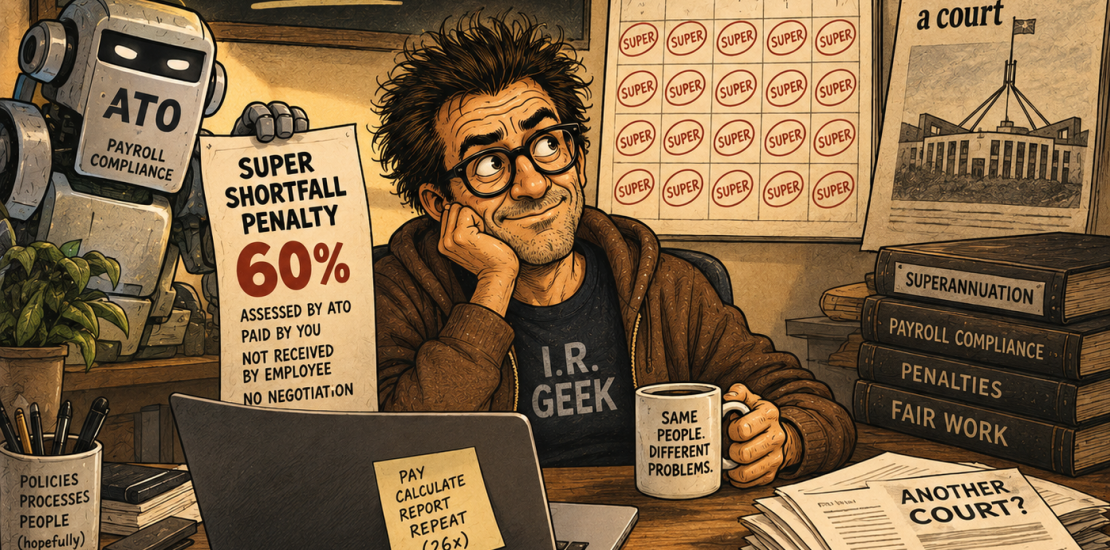
Payday super commenced on 1 July. The ATO now assesses your payroll itself, the penalty starts at sixty per cent of the shortfall, your employee never receives that part, and there is no longer anybody to negotiate with. Three weeks later the Prime Minister announced a court.
In brief
- Payday superannuation commenced on 1 July. The ATO now assesses unpaid super itself, from payroll data it already holds, without waiting to be told.
- The charge includes an administrative uplift starting at 60 per cent. Your employee does not receive it. The Commonwealth keeps it, and the remission discretion that used to reduce these penalties has been removed.
- The Fair Work Ombudsman, looking at the same payroll for the same error, cannot impose a penalty at all. Only a court can, which is what the Fair Work Court announcement three weeks later is actually about.
Positions and interests
Twenty five years in bargaining rooms teaches you one thing ahead of everything else, and it has nothing to do with documents.
Everybody at the table is telling the truth. The log of claims is an honest statement of the union’s position. The response is an honest statement of the employer’s. Neither tells you what either party actually wants, what it will trade, or what it is protecting. The position is the artefact. The interest is the thing that moves, and the interest is what predicts the next six months.
We are trained to read that across a table and then, for some reason, we stop the moment a document arrives with a coat of arms on it. An explanatory memorandum gets read as a statement of fact. It is not. It is a position, drafted by people with interests, and the difference between what it says and what it does is where those interests are visible.
On 9 April 2025 the Prime Minister was asked whether he could rule out changes to negative gearing and the capital gains tax discount. Yes, how hard is it, for the fiftieth time. In May 2026 both were changed, and the Treasurer conceded the promise had been broken and the government had come to a different view. Add the superannuation tax reversal of the previous October and there are two acknowledged departures inside eight months.
Read that as dishonesty and you learn nothing you can use. Read it as a position that held exactly as long as the interest behind it held, and you have a method. The useful question was never whether he meant it. It was what would have to change for him to stop meaning it.
So when payday super commenced on 1 July and nobody in industrial relations read it, because it was filed under payroll and payroll belongs to the people down the corridor with the better chairs, we read it. Not for what it says. For what it does, and for who benefits from the gap between the two.
Then the Prime Minister announced a Fair Work Court three weeks later and everybody wrote about that instead.
They are the same story. It has two halves, and only one of them commenced.
The half that commenced
The penalty that got smaller and did not
Start with the number everyone knows. An employer who failed to lodge a superannuation guarantee statement faced additional charge of up to 200 per cent. That figure has been deployed at nervous clients for thirty years, usually in the second half of the meeting, usually to good effect.
It has been replaced by a late payment penalty of 25 per cent, rising to 50 for a repeat within two years.
A government hardening its position does not cut its headline penalty by three quarters. So either the policy went soft, or we are comparing the wrong things.
We are comparing the wrong things, twice over.
The 200 per cent was never the ordinary outcome. PS LA 2021/3 sets out a four step remission process. Base penalties run from 200 per cent, which applies where the Commissioner must raise a default assessment against an employer who was completely disengaged or phoenixing, down to nil where a statement was lodged before the due date. The worked examples run through remissions of 75 per cent, 78 per cent and the full amount. The headline was the ceiling for the worst behaviour in the country, and underneath it sat a documented sliding scale a competent adviser could walk a client down.
The new penalty has no scale. The explanatory material states that the Commissioner must not remit any part of it. He may amend the assessment if the underlying liability falls. He cannot be talked to.
And the frequency changed underneath all of it. Liability now attaches to each qualifying earnings day rather than each quarter. A fortnightly payroll has gone from four occasions a year on which a shortfall can arise to twenty six.
The explanatory material describes this as delivering smoother payroll management for employers. It is worth pausing on the proposition that doing something twenty six times a year is smoother than doing it four times, and that the party being smoothed is the one performing the extra twenty two.
Where the sixty per cent goes
The late payment penalty is not the main event. Inside the charge sits an administrative uplift, set initially at 60 per cent of the sum of the final shortfalls and the notional earnings for the day.
Its predecessor was twenty dollars per employee per quarter.
The word administrative survived the transition. It is doing a great deal of work.
Section 64B of the Superannuation Guarantee (Administration) Act 1992, as substituted from 1 July, defines what is distributed for the benefit of employees. The list is worth reading twice.
| Component of the charge | Paid into the employee’s fund | Kept by the Commonwealth |
|---|---|---|
| Final SG shortfall | Yes | |
| Notional earnings | Yes | |
| Choice loading | Yes | |
| Administrative uplift, from 60% | Yes | |
| Interest referable to the uplift | Yes | |
| Late payment penalty, 25% or 50% | Yes |
The explanatory material removes any doubt: the uplift is retained in consolidated revenue, in the same way as the administration component it replaced. There is even a note confirming that interest attributable to the uplift stays with the Commonwealth, in case anybody was hoping.
Is sixty per cent what it costs to administer?
The stated purpose is cost recovery, to recoup the cost to taxpayers of the Commissioner’s work investigating and assessing the charge.
That is a testable proposition, so we went looking for the test.
The Australian Chamber of Commerce and Industry told the consultation that the uplift is many multiples of the ATO’s actual administration cost, and called it a double penalty. It recommended the uplift be removed entirely where an employer voluntarily discloses. That submission appears in the Parliamentary Library’s digest of the Bills, which is to say it was made, received, and did not trouble the drafting.
Then we went looking for what administering the charge costs. It is not in the explanatory material. It is not in the impact analysis. It is not in the ATO’s guidance and we could not find it in the portfolio statements.
For scale: the ATO’s departmental budget runs to roughly $4.5 billion a year across every tax it administers, with about 21,500 staff. The superannuation guarantee gap was $5.2 billion in 2021-22. Sixty per cent of the late portion of that, assessed payday by payday, is a figure we would like to see placed beside the administration line it is said to recover.
If a reader has that number, we would genuinely like to hear from them. To be specific about what would settle it: a program cost line in an ATO annual report, a figure in the Treasury portfolio budget statements attributable to superannuation guarantee administration, or anything in the impact analysis we have missed. A ballpark from somebody who has worked inside the program would also do.
The change that looks like a present
Sections 26-95 and 290-95 of the Income Tax Assessment Act 1997 have been repealed. Late contributions are now deductible. So is the charge, including the uplift.
The stated reasoning is unimpeachable, which is what makes it interesting. The charge substitutes for a superannuation contribution, and contributions are deductible. No practitioner would argue with a word of it.
But consider what non-deductibility was doing for thirty years. The entire charge came out of after-tax profit. That is why superannuation guarantee assessments were fought to the last available breath, why so much of our professional lives went into remission submissions, and why the charge was regularly catastrophic rather than merely annoying.
Remove that, and the charge stops being catastrophic and becomes a bill. Bills get paid. Objections evaporate. Collection accelerates.
Whether that was the point or a happy consequence of sound tax logic, the effect is identical. The largest single source of resistance in the system was dismantled in the same instrument that made detection automatic.
Treasury costed the package at $589 million over three years: $1,405 million, then minus $929 million, then $113 million. The steady state is $113 million. The first year is largely an accounting artefact of fifteen months of contributions landing in one financial year.
The bill nobody sent the employees
Which produces the part nobody set out to design.
Concessional contributions count when the fund receives them, not when the earnings arose. A June quarter contribution received in July 2026 sits in 2026-27 alongside a full year of payday contributions. One published example puts an employee $1,996 over the cap, and where no non-concessional room remains the excess can be taxed at 47 per cent.
So a reform to protect retirement savings produced a cohort of people taxed for receiving too much retirement saving at once, through a timing decision made by their employer, about which they were not consulted.
The Assistant Treasurer announced in February that technical amendments would fix this for 2026-27. In May the National Tax and Accountants Association pointed out that this addresses half the problem, and asked for the relief to extend to 2025-26, since employees whose employers moved early are caught in the current income year too.
As at the middle of August we can find no evidence those amendments have been enacted. A major fund’s employer guidance still says relief has been confirmed and that it will update the page when more information becomes available.
The regime arrived on time. The fix for the regime did not.
The half that did not commence
Now the other side of the same payroll.
Superannuation is calculated on ordinary time earnings. Qualifying earnings is built from the same base. The data revealing a superannuation shortfall is the data revealing the wage error underneath it. An annualised salary never properly reconciled was wrong on both sides, in the same pay periods, for the same reason, and has been for years.
So what happens when the Fair Work Ombudsman finds it?
| ATO, on the superannuation | Fair Work Ombudsman, on the wages | |
|---|---|---|
| How it detects | Single Touch Payroll and fund data, continuously | Complaint, audit, or self-report |
| Who assesses | The Commissioner, on his own initiative | Nobody. There is no assessment power |
| Penalty for the underpayment | Applied itself: 60% uplift, plus 25% or 50% late payment penalty | Cannot impose one. Must litigate |
| Penalty for poor records | Part of the same charge | On the spot, up to $109,200 |
| Interest | Applied itself, across the entire charge | Court may order |
| Directors personally | Exposed before assessment | Accessorial liability, through a court |
| Needs a judge | No | Yes, for anything that matters |
Read the fourth row against the third.
The wages regulator can fine you on the spot for failing to keep the records. It cannot fine you for what the records would have shown.
It can issue a compliance notice requiring rectification, under section 716. A compliance notice carries no penalty. If the employer ignores it, the Ombudsman goes to court, and only a court can set a penalty, up to $546,000 or three times the underpayment.
The ATO, since 1 July, does the lot itself. No court, no application, nobody to persuade.
Same payroll. Same error. Same pay periods.
One regulator needs a database. The other needs a judge.
What the difference is worth
The comparison nobody has run is the one between what each regulator actually returns to the Commonwealth.
The Fair Work Ombudsman’s best year on record for court-ordered penalties was 2024-25: $23.7 million, off 73 litigations, including a single $15.3 million order against the operators of Sushi Bay. The year before was $21.2 million, described at the time as the largest in the regulator’s fifteen year history. Infringement notices, the only penalty it can issue without a judge, raised $986,616 across 760 notices in 2023-24.
That is what the wages regulator returns to the Commonwealth in the best years it has ever had.
Treasury’s steady state forecast for the superannuation package is $113 million a year.
Five times the Ombudsman’s all-time record. No litigation, no judge, no investigation, no evidence to assemble. An assessment raised from data the ATO already holds.
And $113 million is Treasury’s number on the assumption that employers largely comply. The superannuation guarantee gap was $5.2 billion in 2021-22. Sixty per cent of whatever share of that is now detected and assessed is the ceiling, and the ceiling is not $113 million.
One distinction matters here and it gets blurred constantly, including by people who should know better. The Ombudsman’s headline figures, $358 million last year and more than $2 billion over five, are back-pay. That money goes to workers. The Commonwealth receives none of it. Only the penalties are revenue, and the penalties are the small number.
The administrative uplift is revenue. All of it.
Why nobody has ever fixed it
Because nobody can.
The superannuation guarantee charge is a tax. That is why it lives in its own Act, and why the payday super package required two Bills rather than one. A tax can be assessed and collected administratively, by an officer, from records, without a court coming near it.
Penalties under the Fair Work Act are the exercise of judicial power under Chapter III of the Constitution. No tribunal, no regulator and no inspector can impose them. Boilermakers, seventy years old and still deciding what an Australian regulator is allowed to do.
You cannot give the Ombudsman the ATO’s powers. It is not a reform successive governments have declined to make. It is unavailable.
Which is what the Fair Work Court announcement actually is. Not a preference, not a flourish, and not really a choice. It is the only lever that exists on the wages side of the same problem.
The Geek assessment
The half of the problem that could be fixed administratively was fixed. It commenced on 1 July with an assessment engine, a penalty schedule, a data feed and a non-remittable default. It is operating on your payroll this fortnight.
The half that needed a court was announced from a lectern at a party conference, with no jurisdiction settled, no design, no timetable, no commencement date and no money. Consultation was promised for later in the year. Three weeks on, nothing has opened.
We are not suggesting anybody planned it that way and we cannot establish it. Data matching was funded in 2023, the legislation passed in 2025, commencement was July, the announcement followed three weeks later. That is a sequence, and a sequence is not a plan.
But it is a fair observation that where a government could act without legislation, funding or a constitutional obstacle, it acted, and the machine is running. Where it could not, it announced.
Now look at how both were sold.
Payday super was presented as protecting workers’ retirement savings, which it does, and the explanatory material offers employers smoother payroll management as well. The Fair Work Court was announced as benefiting employees and employers alike.
Two reforms, both framed as favours to the people they regulate. In one of them the penalty component is retained in consolidated revenue, interest accrues on the penalty, the remission discretion was removed entirely, the charge was made deductible so that it gets paid rather than fought, and the employees it protects are, in the transition year, being taxed for receiving too much of their own superannuation at once, with the promised relief still not enacted six weeks after commencement.
We cannot prove intent and we are not going to try. But a government running a structural deficit, which has broken two explicit tax commitments in eight months on its own Treasurer’s admission, is not an institution whose stated reasons should be taken as the operative ones.
And since the whole argument of this piece is that you should ask who benefits from a stated position, it would be poor form not to apply it here. We are a workplace relations consultancy. We sell the reconciliation work this article says you should do. Read what follows knowing that, and check the sections for yourself rather than taking our word for what they say. That is the point of citing them.
Positions and interests. The position is in the media release. The interest is in section 64B.
The professional consequence is narrower and more precise than it first appears. Discretion has not been abolished. It has been converted into a schedule.
Under the old regime an employer reduced its exposure by persuading a person after the event, inside a published framework that ran all the way down to nil. Under the new one it reduces the uplift by lodging a form before assessment, against a formula in regulations. The lever survives. It moved earlier in time, and it stopped being an argument.
Somewhere in a precedent folder there is a remission letter that has been quietly adapted since about 2011, with the client name swapped out and the exceptional circumstances paragraph reworked according to season. It has been a good letter. It has done real work. It can be deleted.
What to do before the end of the month
Move the payroll and superannuation calendars together. An error used to have 28 days after quarter end in which to be noticed. It now has seven business days, twenty six times a year.
Diarise the voluntary disclosure. It is the only mechanism that reduces the uplift and it closes the instant the Commissioner assesses, which makes it voluntary in roughly the sense that telling the police before they arrive is voluntary. On the arithmetic it is the most valuable thing in the regime.
Brief the directors specifically. Personal exposure now runs on a clock that starts before anyone has assessed anything. Say that one slowly.
Run the reconciliation that finds wage errors, because it finds the superannuation errors in the same pass. They come out of one set of numbers and always did.
The superannuation half of your exposure is being assessed this fortnight, by a system that does not need to ask you anything first.
The wages half is waiting for a court that does not exist yet.
We still want the administration cost figure.