
- July 24, 2026
- Posted by: Justin Prince
- Categories: Employment Law Support, Human Resources and Industrial Relations, Industrial Relations, Workplace Investigations
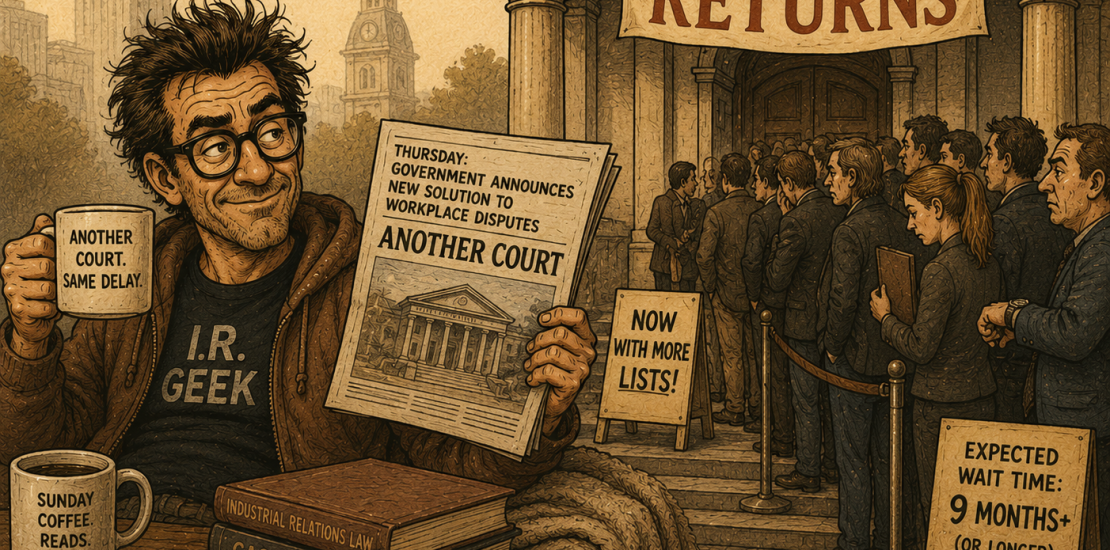
The announcement came out on Thursday, and it will surprise nobody who has ever waited nine months for a Federal Circuit Court listing that the Government’s solution to Australia’s workplace dispute problem is another court.
The Prime Minister, the Minister for Employment and Workplace Relations and the Attorney-General jointly announced a new federal Fair Work Court: specialist judges with workplace relations expertise, designed to work alongside the Fair Work Commission, aimed squarely at the problem of small claims that take two years and cost more than they are worth. Consultation on the design happens this year, which means Thursday’s announcement was really an announcement about a future announcement.
The historical framing is doing quite a lot of work. A new Fair Work Court is described as decades in the making, after the Howard Government abolished the last industrial relations court in 1997. Which is true, in the same way that a house is decades in the making if you knocked one down in 1997 and have been thinking about it ever since. The Industrial Relations Court of Australia was created in 1994 and effectively wound down when its jurisdiction went to the Federal Court. Three years is not long enough to prove a specialist bench works, and not long enough to prove it does not, which is why both sides of the argument have been able to cite it comfortably for thirty years.
What the announcement actually tells us
Very little about the design, which is the honest answer.
No detail on jurisdiction. No detail on whether the Court absorbs the Federal Circuit and Family Court’s workplace jurisdiction or sits beside it. No small claims threshold. Nothing on appeal pathways. Nothing on whether the Commission’s functions change. Consultation will decide all of it, and consultation has not started.
Anyone who sat through the Closing Loopholes rounds will already know what to expect from that sentence.
The pattern is not that nobody gets asked. Everybody gets asked. Ai Group described itself as heavily engaged in consultation with the Government during the development of that legislation, and then noted that most of the engagement had been required to occur on a confidential basis, which is a sentence worth reading twice. Consultation you cannot describe afterwards is consultation whose influence cannot be demonstrated afterwards. From the outside, and frankly from the inside, it becomes very difficult to distinguish from a briefing.
What followed is the part practitioners remember. Employer concerns were addressed, in the sense that some of them were, at the edges. The response from industry was that the bill remained fundamentally flawed and had been rushed. Then the Bill was split at the last minute and the labour hire provisions went through without the substantive concerns being resolved at all, which on Ai Group’s assessment meant the most contested provisions escaped proper scrutiny entirely. The same shape appeared again with the parliamentary inquiry into workplace AI, where ACCI’s position was that months of collecting submissions had produced recommendations that were unbalanced and impractical.
So the honest expectation is this. There will be a consultation. It will be genuine in the sense that submissions will be read and some design detail will move. It will not be genuine in the sense that the existence of the Court, its general shape, and anything already settled politically are on the table, because they are not, and Thursday’s announcement is the evidence of that. A government that intended to consult on whether to build a court would have consulted on whether to build a court.
Which is not a reason to skip it. It is a reason to be strategic about what goes in the submission. Arguing that the Court is unnecessary is arguing with a decision already taken. Arguing about a specific mechanism, how a matter transfers from the Commission, what happens to the section 548 threshold, how the reverse onus operates in a fast-track procedure, has somewhere to land, because that detail is genuinely undecided and nobody in Cabinet holds a firm view on it yet.
The design is where the influence is. It is also where the exposure is.
Where the political pressure sits
The framing of the announcement is underpayment. Both the Prime Minister and the Minister anchored their quotes to workers chasing wages, not unfair dismissal, not general protections, not bargaining disputes. That is worth noticing, because a small claims procedure already exists under section 548, already caps at $100,000, already runs without lawyers as of right, and already sits in the Federal Circuit Court.
If those claims are taking two years, the problem might be the forum. It might also be that the Federal Circuit Court is carrying migration, family law and general federal law with a bench that has been quietly under-resourced for a decade. One of those problems can be fixed with a media release. The other requires money.
What employers should be watching
The interesting question is not the court. It is the seam between the Commission and the court.
The current division is reasonably clear, and it is constitutional rather than administrative, which means no amount of consultation is going to change it. A Fair Work Court cannot arbitrate. The Commission cannot impose penalties. Boilermakers has survived considerably worse ideas than this one.
Where the design gets genuinely difficult is the transfer points. General protections matters that fail conciliation and head to court. Unfair dismissal matters where the jurisdictional objection would be better resolved judicially. Underpayment that surfaces halfway through a Commission dispute. Those transitions are clunky, and a court properly integrated with the Commission could fix them. A court that relabels the existing jurisdiction and orders new stationery will not.
The other thing worth watching is what specialist judges with workplace relations expertise actually produces. Specialist benches develop faster and more confident jurisprudence, which cuts both ways. Faster resolution of arguable points is good news. A judge who has seen four hundred underpayment cases and can identify a reconstructed time sheet from the bar table is a very different proposition to a generalist encountering the Fair Work Act for the third time this year. Employers who have quietly been relying on the second kind of judge should factor that in.
The practical implications
Nothing changes today. Consultation runs through the rest of 2026, legislation follows, and a new federal court needs judges, registries, rules and a commencement date. This is a 2028 proposition at the earliest, and that assumes a level of legislative enthusiasm that court architecture does not usually attract.
Two things are worth doing now anyway.
The first is time-and-wages records. If the design brief is faster and cheaper resolution of underpayment claims, the mechanism will be procedural: simplified pleadings, early determination, and heavy reliance on section 557C where records are inadequate. Section 557C already shifts the burden onto the employer who cannot produce compliant records. A court built for speed will lean on it considerably harder. Records that are technically compliant but practically unreadable are an exposure, not a filing problem, and every payroll system in the country has a folder somewhere that nobody has opened since implementation.
The second is the submission, made on the narrow points rather than the broad ones. Employer associations will file, most employers will read about the outcome afterwards, and by then the design will be settled and the complaining will be free.
The Geek assessment
This is not a change to workplace law. Not one obligation changes, no entitlement moves, and nobody’s exposure altered on Thursday afternoon.
What changed is the signal. A government that builds a specialist court for underpayment claims is a government expecting a great many underpayment claims, and it is doing so alongside wage theft criminalisation, an expanded Ombudsman and three years of compliance-focused amendments. The court is not the policy. It is the delivery mechanism for a policy that has been visible for some time.
The design question that determines whether any of this works is whether the Court is genuinely integrated with the Commission or merely adjacent to it. Integration means a matter moves between conciliation and adjudication without starting again. Adjacency means a new letterhead on the same delay.
There is an instructive example of that distinction currently unfolding. On Monday afternoon every compatible phone in the country will emit a ten second siren as AusAlert is tested nationally, a system responding to the 2020 Bushfires Royal Commission, arriving after more than two years of delay, going live in October. The technology is sound and used in more than thirty countries. The consultation was done. State and territory agencies were involved in the design.
And on Wednesday, four days before the national test and three months before go live, the federal Minister was still meeting her state and territory counterparts, because several jurisdictions intend to keep running their own warning systems alongside the national one, some have signalled reluctance to adopt it at all, and Queensland was still asking how anyone on a landline finds out about a fire. Every one of those questions is about how the new system interacts with the one already operating. None of them are about the technology.
That is the failure mode, and it is not a failure to consult. It is consulting on the wrong question. Everyone agreed the capability was needed. Nobody settled who is in charge when both systems are running, which is the only question that matters at two in the morning with a fire front moving.
A Fair Work Court sitting beside a Fair Work Commission has precisely the same problem, with the added feature that the boundary between them is constitutional and cannot be consulted away. The consultation will attract a great deal of submission about jurisdiction, thresholds and judicial appointments. The question worth pressing is narrower and duller: when a matter needs to move between the two, what happens. If the answer is that it starts again, the Court is a new sign on an old door.
Somewhere in Australia there is a payroll system quietly producing records that nobody has examined since implementation. Its owners have until roughly 2028. History suggests they will use about three weeks of it.