
- September 21, 2026
- Posted by: Justin Prince
- Categories: Employment Law Support, Human Resources and Industrial Relations
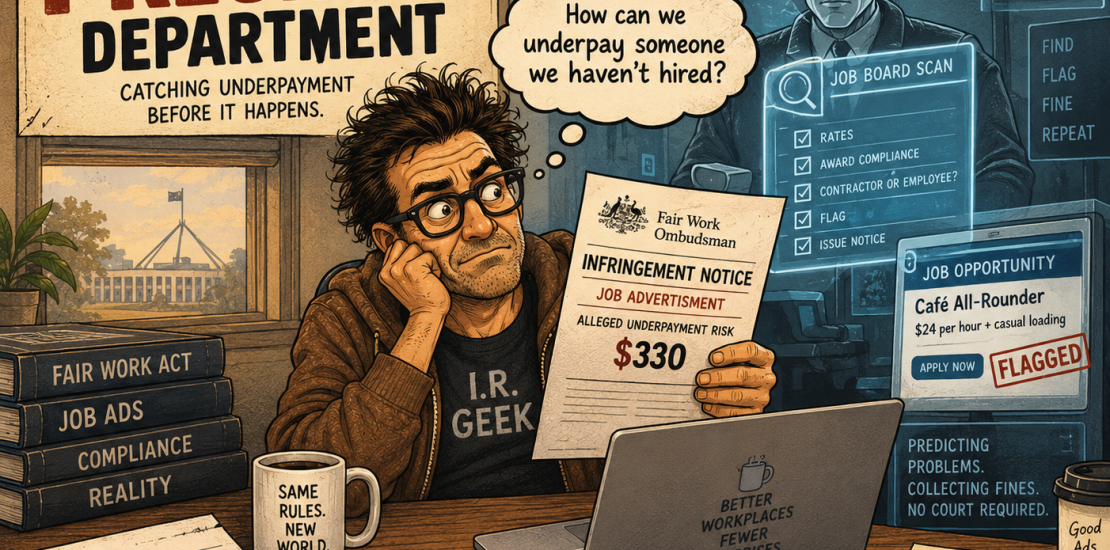
Since March 2023 the Fair Work Ombudsman has been fining employers for job ads, not for underpayments. Nobody has to be hired, nobody has to complain, and in 832 notices nobody has ever argued. The regulator has now said contractor ads are next.
In brief
- Advertising a job below the legal minimum has been an offence since March 2023. The ad is the contravention. Inspectors find them by searching the job boards, and no complaint is needed.
- The average fine last year was $368, about the smallest an inspector can issue. The increase in the maximum on 1 July was indexation, not policy. The whole year’s fines fund roughly seven hours of the agency that collected them.
- The fine is priced below the cost of arguing, so no court has ever looked at the law. The regulator is now using it to decide whether advertised contractors are really employees, and that is the part worth worrying about.
The first most business owners hear of this law is a letter about a job they never filled.
They read it twice. They go looking for the employee who complained and cannot find one, because there isn’t one. Nobody applied. Nobody was hired. Nobody rang the Ombudsman. A Fair Work inspector typed a search term into a job board, found the ad, compared the number in it to the award, and issued a fine. The whole thing, from detection to closure, is finished before the business has worked out what it did.
Somewhere in Australia a manager is holding that letter and asking: “How can we underpay someone we haven’t hired?”
The honest answer is that they didn’t. Since March 2023 the Fair Work Act has made it an offence to advertise a job at a rate below the legal minimum. Not to pay it. To advertise it. The regulator does not have to wait for anyone to be short changed, and Anna Booth, the Fair Work Ombudsman, says so in nearly every release: the aim is to stop underpayment before it occurs.
The Fair Work Act does not punish an underpayment. It punishes the forecast of one.
If that sounds like the plot of a film, it is. In Minority Report, the 2002 Spielberg film built on a Philip K. Dick story, the police run a unit called Precrime. Three seers predict murders before they happen and the police arrest the would-be killer before anyone is harmed. Two things about that system matter here. Nobody can ever check whether a prediction was right, because the crime never takes place. And when one of the three seers disagrees with the other two, the dissent is called a minority report, and it is quietly filed away where nobody reads it.
Hold onto both of those. The Fair Work Ombudsman now has a Precrime department of its own, and it works the job boards.
On 27 August the FWO published the annual figures: 358 fines last financial year, $131,836 paid, 18 per cent more than the year before, and a stated intention to go looking next at ads that call the worker a contractor. Since the power arrived, employers have paid more than $317,000 across roughly 832 notices.
Every employment law update in the country ran those numbers. Here is what we think they mean for the people who actually run businesses.
It was never about the money
Divide $131,836 by 358 and the average fine is $368. That is about the smallest fine an inspector is allowed to issue. The maximum was six times that for an individual and thirty times for a company. The regulator has been operating at the very bottom of its own range since the day it started, and the year before looks the same.
| Year | Notices | Fines paid | Average per notice | Penalty unit |
|---|---|---|---|---|
| 2023-24 | 156 | almost $74,000 | about $474 | $313 |
| 2024-25 | 318 | $111,306 | $350 | $313, then $330 from November |
| 2025-26 | 358 | $131,836 | $368 | $330 |
| Maximum an inspector may issue | 6 units individual, 30 units company | $364 from 1 July 2026 |
You may have read that the maximum fine went up on 1 July, to $2,184 for an individual and $10,920 for a company. It did. Not because anyone decided to get tougher, but because Commonwealth fines are set in “penalty units” and the value of a unit is indexed every three years. It moved from $330 to $364 in July, and every fine in the Act moved with it. Most of the “18 per cent increase” is the same story: more notices, plus a unit that got bigger. Nobody is being hit harder. There are just more of them.
Now put that take against what it costs to collect. The Fair Work Ombudsman runs on roughly $167 million a year and close to a thousand staff. The entire year’s job ad fines are about 0.08 per cent of that. On a daily basis, it funds around seven hours of the agency that collected it. And none of it goes to a worker, because there is no worker. It goes to consolidated revenue.
The entire year’s job ad fines fund about seven hours of the agency that collected them.
So this is not a revenue raiser and it is not a deterrent by size of penalty. We think the $330 is a price set deliberately below the cost of arguing about it, and that is the part worth understanding.
They are not taking away your ability to fight. They are taking away your reason to.
Here is how it works when the letter arrives. An inspector has decided your advertised rate is too low. You have 28 days. You can write to the Ombudsman and ask them to withdraw their own notice, which is the only review on offer. Beyond that, the sole way to challenge it is to refuse to pay and wait for the regulator to take you to court. If you pay, it is not an admission of anything, and the matter is closed for good.
For $330, that decision makes itself. Nobody spends an hour of legal advice on it. Nobody puts it in front of a board. A café cannot afford the fight and a national retailer will never authorise one over a number that small, so the design excludes both ends of the market for opposite reasons.
The result is that in three and a half years, and 832 notices, we cannot find a single court decision on this law. Not one. No judge has ever been asked whether the regulator is reading it correctly. The FWO’s own releases describe court action as something that might happen to repeat offenders, not something that has.
That is the first of the two things from the film. The problem was never the arrests. It was that nobody could check whether the prediction was right, because the crime never took place. This law has the same feature built in. The job never starts, so no employer can show they would have paid correctly, and because everyone pays rather than argues, no court ever looks at it.
The system produces forecasts and receipts, and nothing in between.
To be fair to the design, this is also what stops a suburban restaurant being dragged through court over a pay line in an ad. You cannot have cheap, quick, proportionate enforcement and full judicial scrutiny of that enforcement from the same instrument. On the spot fines have worked this way for decades. Our objection is not to the tool. It is to what the tool is now being pointed at.
Where the line is
The three examples the FWO chose to publish tell the story.
| Example | Advertised | Award rate | Fine |
|---|---|---|---|
| Melbourne fast food outlet, casual | $24 to $30 an hour | $33.19, casual, lowest level | $330 |
| Sydney restaurant, wait staff | $24 to $26 an hour | $30.35, casual, introductory level, the lowest rate in the award | $330 |
| South Australian transport business, courier driver, ABN required | $30 to $32 an hour, three days a week including Saturdays | Inspectors decided the driver was an employee and the rate fell below the award Saturday rate | $330 |
A Melbourne fast food shop advertised a casual at $24 to $30 an hour. The award rate for a casual on the lowest level at the time was $33.19. A Sydney restaurant advertised wait staff at $24 to $26 against an award rate of $30.35. We checked both figures and they are right to the cent, and in the restaurant case the regulator measured against the lowest rate in the whole award, the one reserved for someone with no experience. The ad was still $6.35 short.
Those two are arithmetic. Number in the ad against number in the award. We have no quarrel with a cheap, uncontestable fine being used to enforce arithmetic. If your ad says $24 and the award says $33, there is nothing to argue about, and $330 is a fair price for having it pointed out.
The third example is different. A South Australian transport business advertised a courier driver for three days a week including Saturdays, at $30 to $32 an hour, and required an ABN. Inspectors made some enquiries, decided the driver would really have been an employee rather than a contractor, and decided the rate would have been below the Saturday rate in the transport award. The business paid $330 and thanked the FWO for the guidance.
Think about what happened there. An inspector decided that a working relationship which did not yet exist, between people who had never met, was employment and not contracting, from a job ad. Whether a worker is an employee or a contractor is one of the hardest questions in this area of law. The High Court spent 2022 settling it one way and Parliament spent 2024 reversing that. It is now being decided by an inspector, on an advertisement, at a price that guarantees you will agree.
Automating arithmetic is fine. Automating the employee versus contractor call is something else.
That is the line, and the regulator has said in plain terms that contractor style ads are the priority for the year ahead.
It could not have done this in 2023. Back then the law said the written contract was what mattered, and an inspector looking at an ad had no contract to look at. In August 2024 Parliament changed the test to what the relationship is really like in practice: who controls the hours, who sets the days, who bears the risk. A job ad is a remarkably good source of exactly that. Fixed days. Fixed hours. Saturdays because you need Saturdays covered. An ABN demanded as a condition of getting the work. It is all the evidence they need, published by you, with a date on it.
Where it goes from here
The only thing limiting this system is how many ads an inspector can read, and that limit is disappearing. The FWO said back in 2024 that it wanted better tools for wider surveillance of job ads. Checking every live ad in the country against the right award and roster is a solvable problem now. Keep the fine at $330, drop the cost of finding the ads, and the count goes from 358 to many thousands without a new law, an announcement or a hearing. Watch the number of notices in the next two annual reports, not the dollars.
Two things will go wrong with it, and we would put money on both.
The law only catches an ad that states a rate. An ad that says nothing about pay is not caught. So the closer enforcement gets to total, the stronger the incentive to publish no rate at all, and a regime built to protect workers from bad numbers ends up removing the numbers. And the ads it was written for, the $7 an hour bar work, the post in a community language group, the card in a restaurant window, were never on the job boards being scanned. Total visibility over Seek gives you total visibility over employers organised enough to use Seek and careless enough to get the rate wrong. The predatory end of the market is not on Seek.
If this sounds familiar, it should. Payday super, live since 1 July, runs the same design: smaller penalties applied far more often, triggered automatically from payroll data rather than from complaints, and structured so that paying is easier than arguing. The money side is different, because payday super was costed as a revenue measure and this was not. The enforcement design is identical. High frequency, low sanction, priced below the cost of resistance. We will come back to that one.
What we would actually do
Treat the job ad as a pay document. In most businesses it is written by the hiring manager and seen by nobody who can price it. One person with the pay guide approves the rate line before it goes live.
Price the roster, not the role. If the ad mentions weekends, evenings or shifts, the number has to clear the penalty rate for those hours, and the casual loading on top. A single flat rate across mixed hours is usually wrong. Both hospitality examples above were ranges, and in both cases the bottom of the range was the problem. For this law, the bottom of your range is your advertised rate.
Do not require an ABN in an ad without asking yourself whether the person is really a contractor. The ad is now evidence of the arrangement you intended, and it will be read back to you by someone who has already decided what it means.
Check every live ad in the first week of July. Award rates move on 1 July, ads outlive pay periods, and an ad that was lawful in June breaks the law in August without anyone touching it.
And one decision that sits above all of those. Paying one of these notices settles nothing except that notice. But if the notice says your contractor was really an employee, and you run fifty contractors on the same arrangement, the $330 is not the exposure. Agreeing with the regulator’s view of your workforce is. For a business with two hundred live ads, whether to pay is a business decision about the whole book, not a legal decision about one fine.
The $330 is not the exposure. Agreeing with the regulator’s view of your workforce is.
The Geek assessment
This is not new law and it is not a crackdown. Volume is up, severity is flat, and the increase in the maximum is indexation. Anyone who told you penalties were hiked read a Treasury formula and called it policy.
What is new is the use. A law built to stop below-award pay rates has become a tool for catching contractor misclassification, applied at the cheapest point in the enforcement chain, on facts that never reach a court. The regulator did not need a new power for that. It needed a change to the definition of employee, a way to read the job boards at scale, and a fine low enough that nobody argues. It has all three.
Since the piece tells you to check your ads before you publish them, it is only fair to say that we are a workplace relations consultancy and that is work we do. Read the recommendations knowing that, and check the figures against the FWO’s own releases rather than taking our word for them. That is why the sources are in the tables.
Industrial relations does not usually change through landmark court decisions. It changes because a regulator finds a provision that costs nobody enough to argue about, and uses it quietly while everyone reads the headline number instead of dividing it by the number of notices.
Which leaves the second thing. In the film, the minority report was the dissenting forecast the system filed away and nobody read. In this one, it is the court decision nobody has asked for.